SOFTWARE.
UPLINK PLUS.
DESCRIPTION.
UpLink Plus is NETRI’s electrophysiology analytics software designed to process and structure recordings generated from compartmentalized neuronal microfluidic devices. The software interfaces with the Axion BioSystems’s Maestro PRO or EDGE environment and enables automated analysis of neuronal activity signals across multiple compartments and microchannels.
By leveraging NETRI’s device architecture and channel combinations, UpLink Plus converts raw electrophysiological recordings into structured datasets of neuronal network metrics, enabling quantitative assessment of neuronal responses to pharmacological or biological perturbations.
METRICS EXTRACTION.
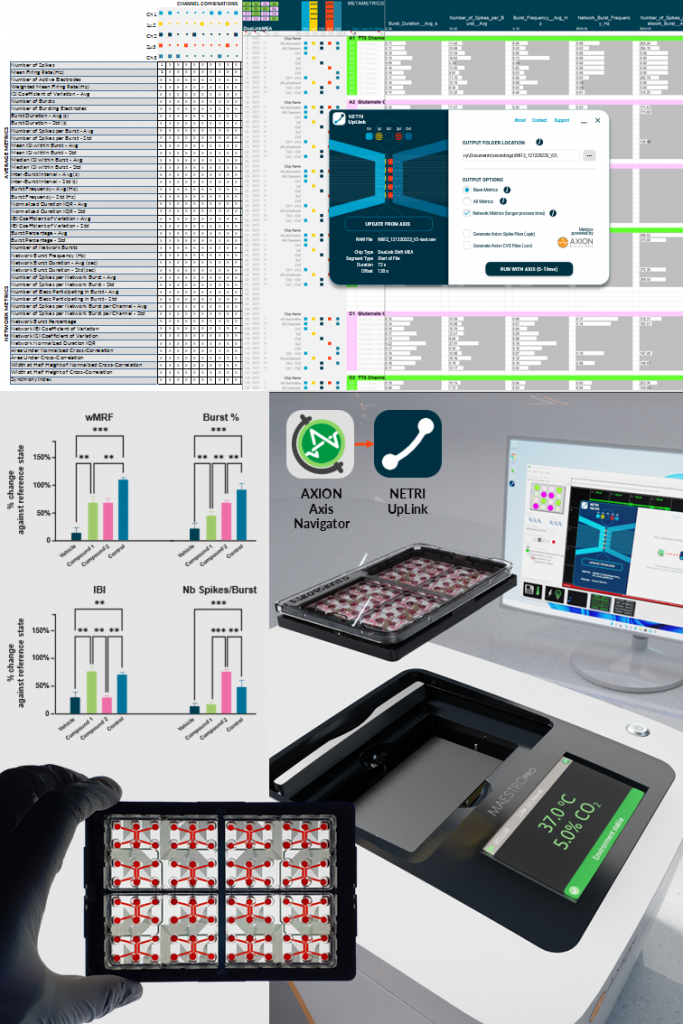
UpLink Plus extracts a comprehensive set of electrophysiological metrics at electrode, channel, and network levels. The software analyzes neuronal recordings across multiple channel combinations to generate a large dataset of functional descriptors characterizing neuronal activity.
In total, the system enables access to over 1300 electrophysiological parameters, including network-level activity metrics and electrode-level measurements. These parameters are automatically compiled into a structured Metametric Report, allowing standardized analysis across experiments and compounds.
USABLE GRAPHS (OUTPUT).
The Metametric Report generated by UpLink Plus enables rapid visualization and interpretation of neuronal activity metrics. The software facilitates the creation of publication-ready graphs and comparative figures for multiple experimental conditions.
These outputs allow researchers to efficiently analyze compound-induced changes in neuronal network activity, supporting experimental decision-making and the generation of reproducible analytical reports for preclinical research.
•Publication: Towards a quality control framework for cerebral cortical organoids.
•Application Note: Traumatic Nerve Injury Platform.
•Publication: Functional discrimination of CSF from Alzheimer's patients in a brain on chip platform.
•Poster: Translational brain-on-a-chip models for Alzheimer's disease drug discovery.
NaaS HUB.
DESCRIPTION.
NaaS Hub is NETRI’s advanced analytics platform designed to convert electrophysiological metrics into digital biological signatures that characterize the functional impact of compounds or biological conditions.
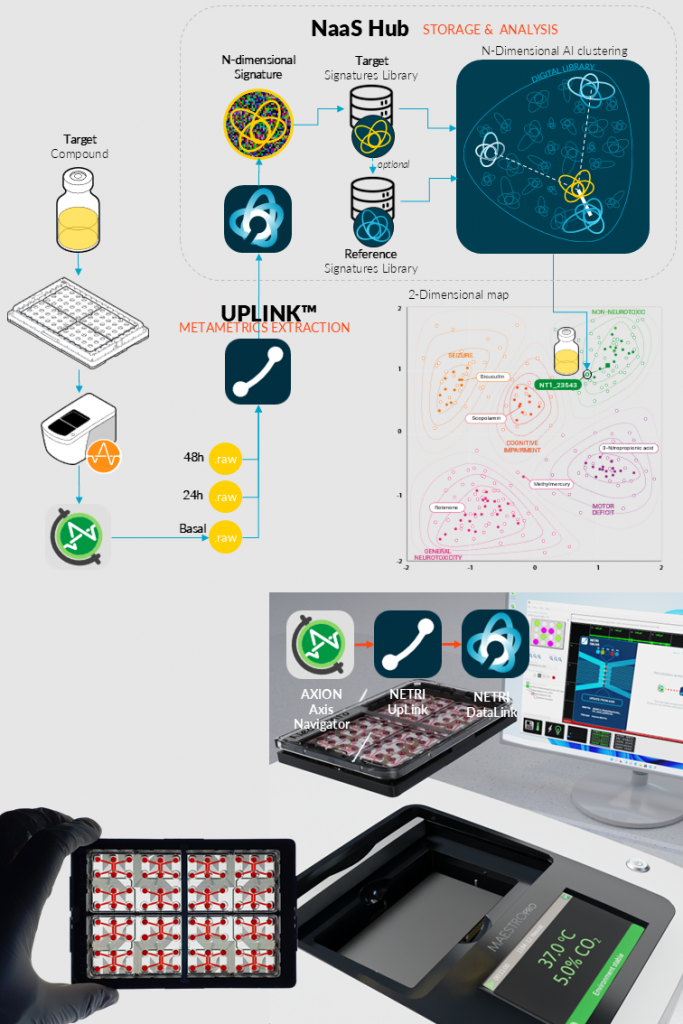
The software operates on the datasets generated by UpLink Plus and applies a pipeline combining data extraction, statistical processing, and AI-driven clustering. This approach enables the construction of multi-dimensional signature maps describing neuronal responses to compounds, diseases, or environmental perturbations.
EXTRACTION.
The NaaS workflow begins with the extraction of electrophysiological information from raw neuronal activity recordings. Electrical signals generated by neuronal networks are amplified and processed to identify spikes and activity events.
Using NETRI’s analytics environment, these signals are converted into MEA-derived functional metrics at electrode, channel, and network levels. Compound-treated states are then compared to reference baseline states to generate relative functional descriptors that form the basis of digital neuronal signatures.
DECORRELATION.
Many electrophysiological metrics are intrinsically correlated. To avoid redundancy and improve the analytical power of the dataset, NaaS Hub applies a decorrelation process that identifies and removes highly correlated parameters.
By isolating metrics with low statistical correlation (typically Pearson correlation < 0.8), the platform ensures that each selected parameter contributes independent information, preventing metric double-counting and improving the robustness of downstream analyses.
MAPPING.
NaaS Hub applies machine learning algorithms to structure the resulting multi-dimensional metric space. Each compound or biological condition is represented as a digital signature vector positioned within this space.
Through clustering and similarity analysis, the system generates reference signature maps that enable compound classification, detection of functional similarities, and identification of unexpected relationships between treatments. These maps support the evaluation of off-target effects, neurotoxicity risks, and therapeutic potential.
The NaaS-in-the-Loop approach integrates biological modeling and AI-driven prediction to accelerate compound discovery and optimization. By training a biological foundation model on large libraries of neuronal digital signatures associated with known compounds and pathways, the system can predict functional outcomes of new molecular combinations.
This approach enables the generation of predicted digital signatures associated with receptor activation or pathway modulation, supporting the design of compounds capable of selectively activating or suppressing specific biological responses within neuronal systems.
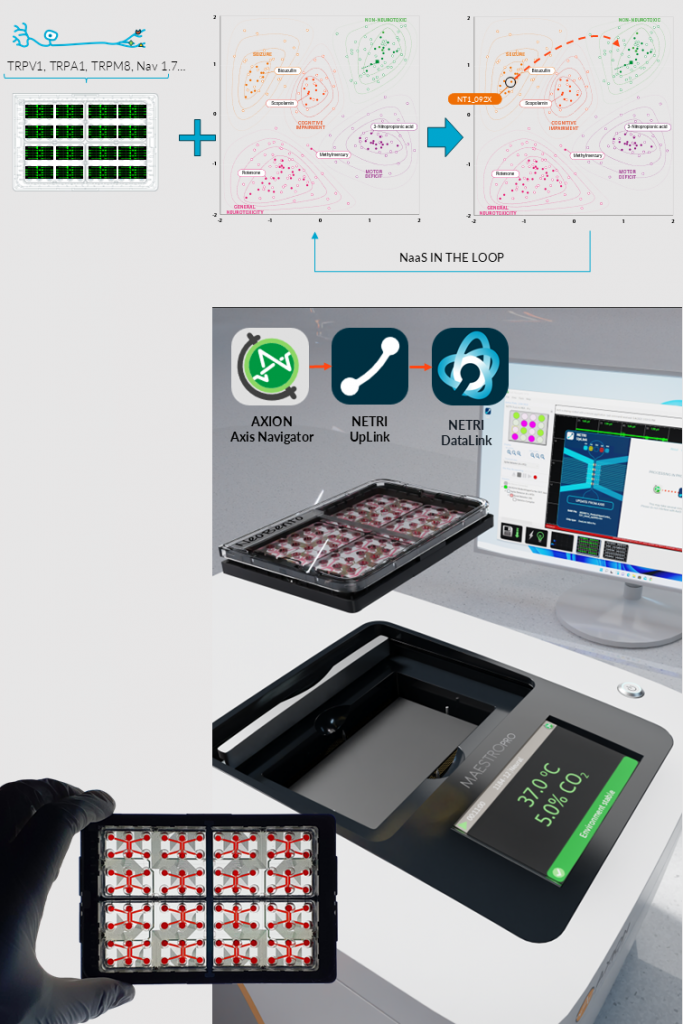
NaaS IN THE LOOP.
•Poster: Digital Signature Library: using neurons as universal bio-digital sensors.
•Poster: Compartimentalized MEA Pain(s)-on-chip platform.
•Press Release: NETRI announces a partnership with ANSES to assess the neurotoxicity of pesticides.
•Poster: Digital Signature Library: using neurons as universal bio-digital sensors.
•Poster: Digital Signature Library: using neurons as universal bio-digital sensors.
•Poster: Compartimentalized MEA Pain(s)-on-chip platform.
•Poster: Digital Signature Library: using neurons as universal bio-digital sensors.