
NETRI wins the France Biotech HealthTech Awards in the Techbio category: Key facts
•Company: NETRI
•Award: Trophée HealthTech 2026
•Organization: France Biotech
•Category: TechBio (breakthrough innovation at the interface of biology, data and engineering)
•Technology: Neurons as a Sensor (NaaS™)
•Core innovation: Human neuronal networks used as functional, quantitative biological sensors
•Key applications: Drug development, safety, toxicity and efficacy prediction
•Impact: Improved clinical predictivity, reduced animal testing, accelerated drug development
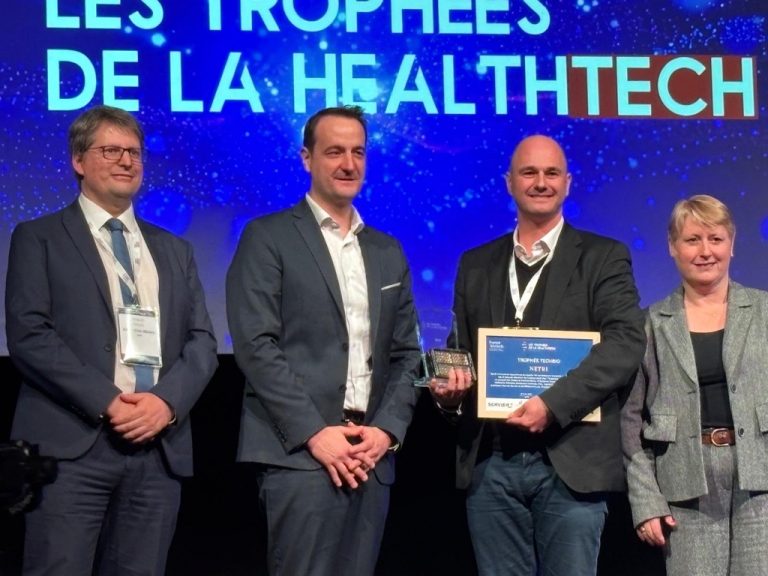
NETRI WINS THE FRANCE BIOTECH HEALTHTECH TROPHIES IN THE TECHBIO CATEGORY FOR ITS “NEURONS AS A SENSOR” PLATFORM.
A recognition of a breakthrough TechBio approach
NETRI is honored to have received the HealthTech Awards in the Techbio category, organized by France Biotech.
This award, dedicated to emerging TechBio innovations, recognizes technologies at the intersection of biology, engineering and data science capable of transforming the future of healthcare innovation.
For NETRI, this distinction acknowledges a foundational scientific and technological shift: the ability to measure human biology through function, using neurons as integrated biological sensors.
Addressing the translational gap in drug development
Drug development continues to face a major structural limitation: the lack of predictive preclinical models.
Conventional approaches—whether in vitro or animal-based—often fail to:
• Accurately reflect human physiology
• Capture complex, multi-cellular interactions
• Predict clinical efficacy and toxicity
This gap results in high attrition rates, increased development costs, and delayed access to innovative therapies.
NETRI addresses this challenge through the development of New Approach Methodologies (NAMs) combining human biology, microengineering and artificial intelligence.
“Neurons as a Sensor”: transforming biology into quantitative data
At the core of NETRI’s platform lies a proprietary concept: Neurons as a Sensor (NaaS™).
This approach consists of transforming human neuronal networks into functional, quantitative biosensors, capable of converting the effect of a drug candidate into measurable electrophysiological signals.
Unlike traditional models relying on static endpoints (viability, morphology), NaaS™:
• Captures dynamic functional responses
• Provides early and sensitive detection of biological effects
• Generates predictive signatures correlated to clinical outcomes
This paradigm shift enables a more integrated and human-relevant understanding of drug effects.
A fully integrated TechBio platform.
NaaS™ is built on the convergence of three technological pillars:
1/ Advanced microphysiological systems
NETRI develops proprietary compartmentalized organ-on-chip devices, enabling:
• Co-culture of multiple human cell types
• Controlled microenvironments
• Functional innervation of any tissues
Coupled with electrophysiological recording systems, these devices allow direct, quantitative measurement of neuronal activity within complex biological models.
2/ Human biology at scale
The platform integrates human induced pluripotent stem cells (hiPSCs) and derived cell types, including:
• Neuronal and non-neuronal cells
• Immune and hepatic cells
• Reconstructed tissues and organoids
This enables the generation of human-relevant, disease-specific models across multiple applications.
3/ AI-driven data exploitation
NaaS™ converts biological responses into multidimensional electrophysiological datasets, analyzed using:
• Machine learning algorithms
• Proprietary signature generation tools
• Structured data libraries linking preclinical signals to clinical outcomes
This data-centric approach allows:
• Predictive modeling of drug responses
• Mechanistic insights
• Identification of failure risks early in development
Broad applications across therapeutic areas.
Originally developed in neuroscience, the NaaS™ platform has demonstrated its relevance across multiple domains:
• Oncology (tumor–nerve interactions, Chemotherapy-Induced Peripheral Neuropathie (CIPN))
• Neurology (neurodegenerative and neuroinflammatory diseases)
• Pain (peripheral and central sensitization)
• Dermatology (neuro-cutaneous interactions and inflammation)
This cross-domain applicability highlights the central role of neuronal function as a universal integrator of biological responses.
From research to industrial scale.
Since its creation in 2018, NETRI has evolved from academic research to an industrial TechBio platform. Recent milestones include:
• Launch of a 1,100 m² production facility dedicated to organ-on-chip manufacturing
• Deployment of industrial-scale production capabilities
• Ongoing automation to ensure reproducibility and scalability
In parallel, NETRI has established strategic collaborations with pharmaceutical companies, CROs and regulatory stakeholders (partnerships in dermatology and chemical safety assessment, for exemple).
These initiatives support the standardization and regulatory acceptance of NaaS™ within the NAMs framework.
Enabling a new generation of predictive and ethical research.
Beyond technological innovation, NETRI contributes to a broader transformation of biomedical research by:
• Enhancing clinical predictivity
• Reducing reliance on animal testing
• Supporting regulatory evolution toward human-relevant methodologies
By generating actionable functional data, NETRI enables more informed decision-making in early-stage R&D, ultimately contributing to faster, safer and more cost-effective drug development.
A strategic positioning in the TechBio landscape.
Receiving the France Biotech HealthTech Awards in the Techbio category confirms NETRI’s position as a key player in the emerging TechBio ecosystem, where biology, engineering and data converge. The company’s model combines:
• Scientific breakthrough (functional neuronal sensing)
• Industrial execution (scalable platform)
• Data-driven value creation (predictive signatures and proprietary datasets)
This integrated approach positions NETRI at the forefront of a new generation of technologies shaping the future of drug development.