Drug Induced Peripheral Neuropathy (DIPN).
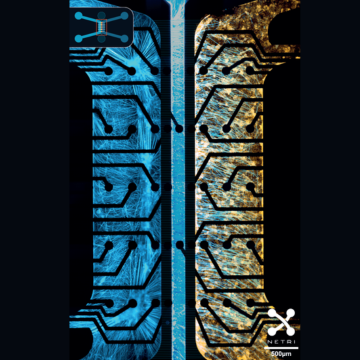
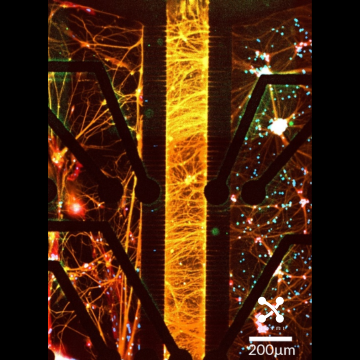
Innervated Skin model recreates functional interactions between sensory neurons and keratinocytes within a compartmentalized electrophysiology platform (compatible with Axion BioSystems's Maestro PRO and EDGE). This configuration enables direct recording of neuronal activity in response to cutaneous stimuli or injury.
• Pruritus: controlled activation of pruritic pathways through keratinocyte-derived mediators (e.g., ATP, lactic acid) or direct compound exposure.
• Wound Healing: reproducible injury can be applied to the keratinocyte layer to mimic tissue damage.
Skin Model.
Neuromuscular Junction (NMJ) model recreates functional connectivity between motor neurons and skeletal muscle within a compartmentalized electrophysiology platform (compatible with Axion BioSystems's Maestro PRO and EDGE). This configuration enables simultaneous recording of motor neuron activity and muscle contraction, providing a direct functional readout of NMJ.
• Botox-like Applications : evaluation of compounds modulating neuromuscular transmission, including synaptic blockade mechanisms.
• Amyotrophic Lateral Scleroris: healthy or patient-derived motor neurons (e.g., C9orf72) to model ALS-related neuromuscular dysfunction.
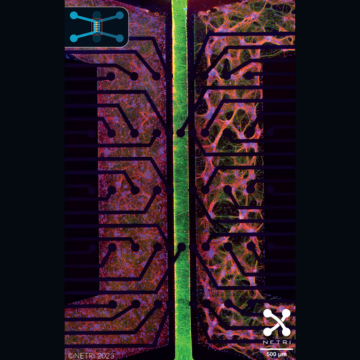
Inflammatory Pain.
Glutamatergic–GABAergic co-culture model reconstructs human excitatory/inhibitory network dynamics within a compartmentalized electrophysiology platform (compatible with Axion BioSystems's Maestro PRO and EDGE). Selective compartmental exposure enables localized pathological induction while preserving an internal functional reference. The system allows direct monitoring of firing rates, synchronization, and network stability.
• Alzheimer’s Disease: selective Aβ exposure induces AD-relevant dysfunction in targeted neuronal populations.
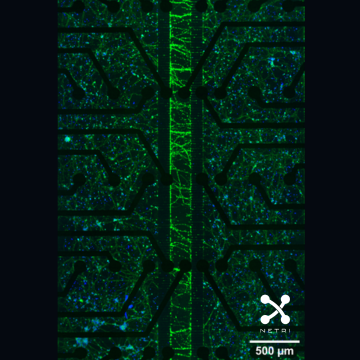
Drug Induced Seizure (DIS).
Dopaminergic–Glutamatergic co-culture model recreates functional interactions between midbrain dopaminergic neurons and cortical glutamatergic neurons within a compartmentalized electrophysiology platform (compatible with Axion BioSystems's Maestro PRO and EDGE). Selective exposure to misfolded protein oligomers enables controlled induction of Parkinson’s disease–like pathology while preserving network connectivity for functional assessment. The architecture allows study of dopaminergic vulnerability and its impact on excitatory network dynamics.
• Parkinson’s Disease: localized induction of oligomer-driven stress triggers dopaminergic dysfunction and progressive network alterations..
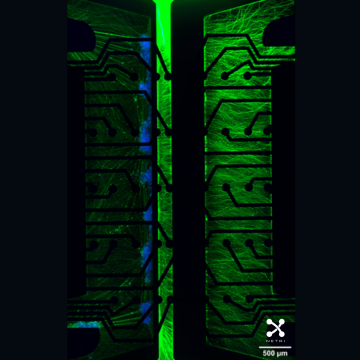
Diabetic Peripheral Neuropathy (DPN).
Cortical–Striatal co-culture model reconstructs directional connectivity between cortical glutamatergic neurons and striatal GABAergic medium spiny neurons within a compartmentalized electrophysiology platform (compatible with Axion BioSystems's Maestro PRO and EDGE). The system enables controlled, channel-guided axonal projection from cortex to striatum, allowing precise monitoring of functional connectivity and transport dynamics across defined microchannels.
• Huntington’s Disease: modelling of selective degeneration of striatal GABAergic neurons characteristic of Huntington’s disease.
Emetic & Nausea Response.
Cortical–Striatal co-culture model reconstructs directional connectivity between cortical glutamatergic neurons and striatal GABAergic medium spiny neurons within a compartmentalized electrophysiology platform (compatible with Axion BioSystems's Maestro PRO and EDGE). The system enables controlled, channel-guided axonal projection from cortex to striatum, allowing precise monitoring of functional connectivity and transport dynamics across defined microchannels.
• Huntington’s Disease: modelling of selective degeneration of striatal GABAergic neurons characteristic of Huntington’s disease.
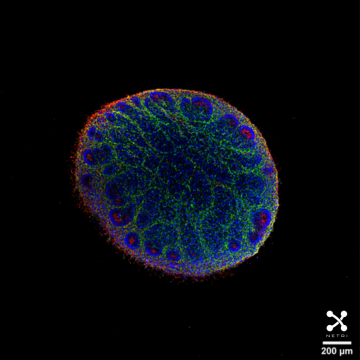
Amyotrophic Lateral Sclerosis.
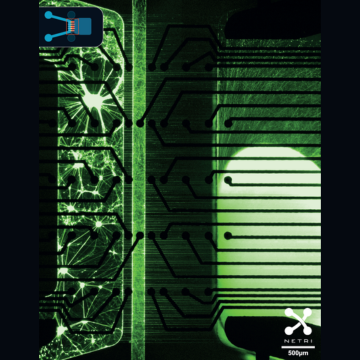
CNS 3D Organoids platform enables functional innervation and recording of brain organoids and complex neural spheroids, within a compartmentalized electrophysiology platform (compatible with Axion BioSystems's Maestro PRO and EDGE). Neurons can be embedded within or directionally connected to the 3D structure, enabling direct monitoring of:
• Network firing dynamics, synchronization and oscillatory behavior.
• Maturation stabilization, neurodegeneration-induced dysfunction.
• Compound-mediated rescue effects
General CNS Neurotoxicity (pharma).
Tumoroids Innervated platform enables controlled innervation of peripheral organoids, multicellular spheroids, and tumoroids within a compartmentalized electrophysiology platform (compatible with Axion BioSystems's Maestro PRO and EDGE). This configuration allows real-time interrogation of neuro–tissue interactions, including:
• Neuron-driven modulation of tissue activity and tumor-induced neuronal activation.
• Compound effects on innervation density and functional connectivity.
General CNS Neurotoxicity (chemicals, pesticides).
CNS 3D Organoids platform enables functional innervation and recording of brain organoids and complex neural spheroids, within a compartmentalized electrophysiology platform (compatible with Axion BioSystems's Maestro PRO and EDGE). Neurons can be embedded within or directionally connected to the 3D structure, enabling direct monitoring of:
• Network firing dynamics, synchronization and oscillatory behavior.
• Maturation stabilization, neurodegeneration-induced dysfunction.
• Compound-mediated rescue effects