HARDWARE.
ECM BIOMIMESYS® .
COMPOSITION.
BioMIMESYS® is a biofunctionalized hydro-scaffold designed to reproduce the key biochemical, structural, and mechanical properties of native extracellular matrix (ECM) . The platform is based on a hyaluronic acid backbone functionalized with adhesion ligands and structural proteins such as collagen, combined with peptide-based cross-linkers to form a stable and physiologically relevant hydrogel network.
This patented architecture generates an interpenetrated HA–collagen matrix with tunable stiffness (typically 100 Pa to <15 kPa), enabling the formation of tissue-like microenvironments that support cell organization, differentiation, and long-term viability. Unlike conventional hydrogels, BioMIMESYS® is engineered to better reproduce organ-specific ECM, providing a more physiologically relevant substrate for advanced 3D cell culture systems.
FORMAT & RELATED APPLICATIONS.
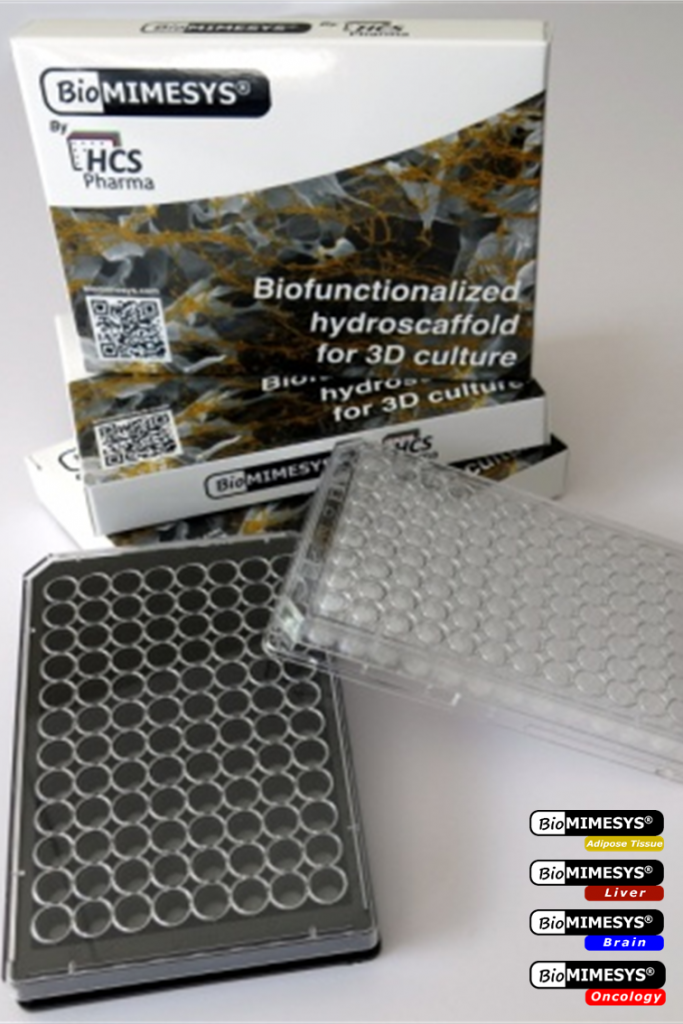
BioMIMESYS® is available in standard multi-well plate formats, enabling straightforward integration into existing laboratory workflows and compatibility with common imaging and analytical platforms. The scaffold supports the formation and maturation of a wide range of 3D cellular models, including organoids, spheroids, and tumoroids.
The platform is used to generate physiologically relevant models such as 3D liver organoids, pancreatic organoids, adipose tissues, brain organoids, and tumor models, supporting applications in disease modeling, drug screening, and translational research. Its standardized format enables scalable experimentation while maintaining controlled ECM composition and reproducible tissue organization.
•Publication: In vitro differentiation modifies the neurotoxic response of SH-SY5Y cells.
•Publication: In vitro three-dimensional cell cultures for bone sarcomas.
•Publication: A Promising Combination for Neuroendocrine Tumors Treatment.
•Publication: ABCA1/ABCB1 Ratio Determines Chemo- and Immune-Sensitivity in Human Osteosarcoma.
•Publication: Reticulated hyaluronan hydrogels: a model for examining cancer cell invasion in 3D.
VASCULARIZATION.
MULTIFLUIDICS™.
NETRI microfluidic platforms enable the integration of vascular-like interfaces within advanced in vitro tissue models, allowing the controlled interaction between multiple cellular compartments. By combining microfluidic flow, nanoporous membranes, and compartmentalized architectures, these systems reproduce key aspects of physiological barrier and vascular environments, supporting more predictive studies of tissue physiology, drug transport, and cell–cell communication.
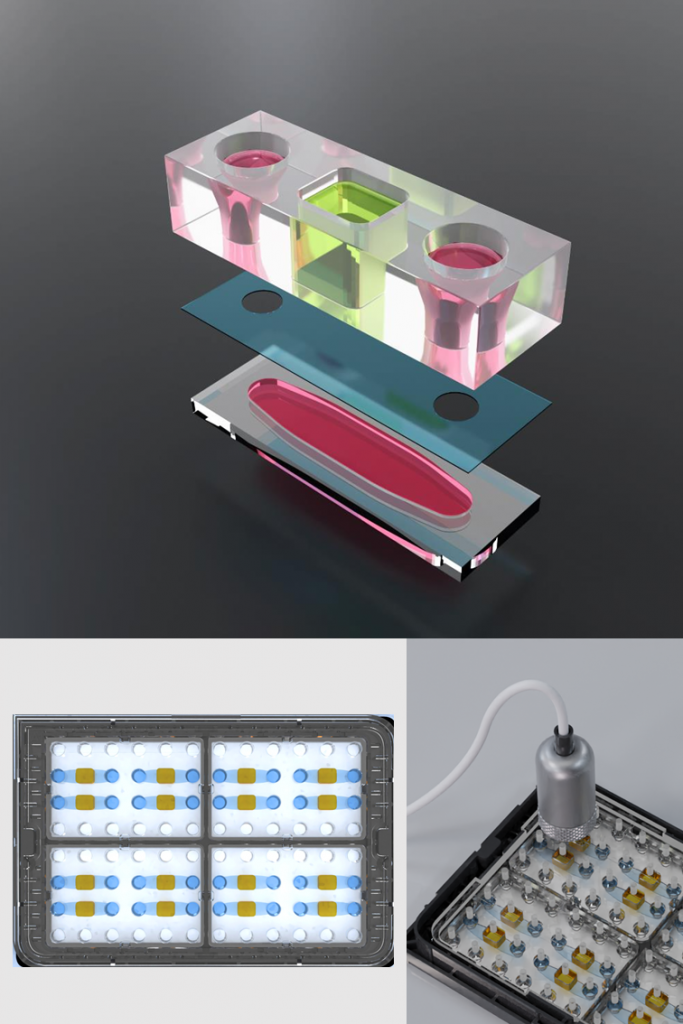
The MultiFluidics platform integrates an open-well culture chamber positioned above a microfluidic channel, separated by a transparent nanoporous membrane that allows the diffusion of soluble factors while maintaining compartmentalization. The open-well configuration supports a wide range of epithelial or tissue cultures, including 2D layers, 3D tissues, organoids, or explants, while the lower microfluidic channel can host endothelial cells to recreate vascular-like interfaces.
TEER COMPATIBILITY.
NETRI vascularized platforms are designed to be fully compatible with Trans-Epithelial/Endothelial Electrical Resistance (TEER) measurements, enabling quantitative monitoring of barrier integrity and permeability. The system integrates custom STX electrodes with a standard 9 mm pitch, aligned with the MultiFluidics platforms geometry to ensure reproducible measurements. A dedicated interface developed with NeoBento™ ensures consistent electrode positioning and repeatable readouts across experiments.
The platform is compatible with EVOM™ 3 instrumentation from World Precision Instruments (WPI) and generates TEER values comparable to standard Transwell-type measurements, allowing researchers to monitor barrier formation, maturation, and disruption in a familiar and validated framework.
•Publication: Towards a quality control framework for cerebral cortical organoids.
•Poster: Development of a brain-organoid-on-chip platform for neurotoxicity testing.
•Publication: Towards a quality control framework for cerebral cortical organoids.
•Poster: Development of a brain-organoid-on-chip platform for neurotoxicity testing.
INNERVATION.
COMPARTMENT & CULTURE.
NETRI NeuroFluidics platforms enable the development of innervated in vitro tissue models by combining compartmentalized neuronal cultures with functional electrophysiological readouts.
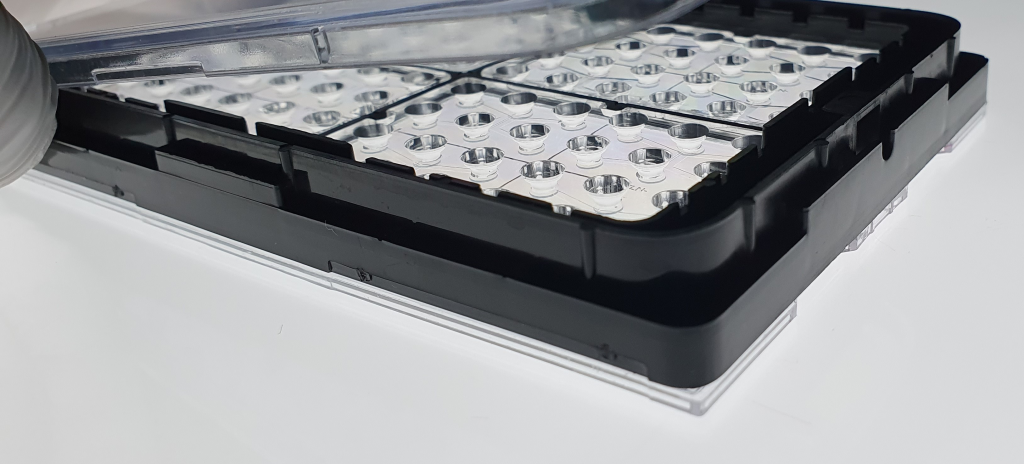
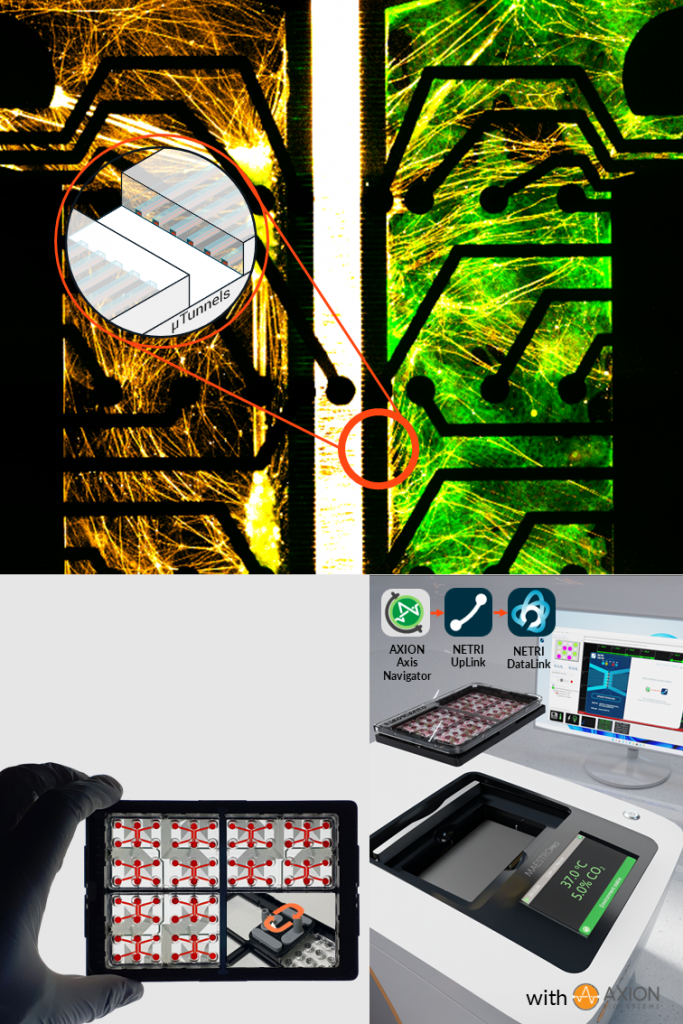
NeuroFluidics platforms incorporate compartmentalized microfluidic architectures connected by microchannels that guide neurite growth while maintaining fluidic isolation between compartments. These microchannels are dimensioned to allow neurite extension while preventing cell body migration, enabling the controlled formation of neuronal networks between separated cellular populations. This configuration allows researchers to culture multiple neuronal or tissue populations in distinct compartments, where somas remain localized while axons and dendrites extend through the microchannels to establish functional connections. The system can reproduce physiologically relevant configurations such as organ–nerve interfaces, spinal–peripheral connections, or neuron–target tissue interactions, while allowing compounds to be applied selectively to specific compartments.
ELECTROPHYSIOLOGY.
NETRI’s compartmentalized platforms integrate microelectrode array (MEA) technology to monitor neuronal activity and network dynamics in real time. The electrodes are positioned directly within the microfluidic culture chambers, enabling the recording of extracellular electrical signals generated by neuronal populations and their connected networks.
This architecture supports the analysis of neuronal firing patterns, and network connectivity across multiple compartments. Advanced signal processing enables the extraction of large sets of electrophysiological parameters, providing quantitative insights into neuronal function and pharmacological responses in complex innervated models. The platform supports both 2D neuronal networks and 3D innervated tissue models, including organoids and co-culture systems.
JUMPER™.
The JUMPER technology extends NETRI’s microfluidic platforms toward multi-organ-on-chip configurations by enabling the connection of multiple microphysiological systems through controlled perfusion pathways.Using dedicated connector modules, independent cultures can be linked together to create open or closed fluidic loops, allowing the circulation of media and signaling molecules between different tissue models. This architecture enables the study of inter-organ communication, systemic pharmacological responses, and multi-tissue physiological interactions within a modular experimental setup.
By connecting perfusion channels across devices, JUMPER technology supports the development of scalable multi-organ platforms, opening new possibilities for integrated human-relevant models in drug development and systems biology.
•Publication: Towards a quality control framework for cerebral cortical organoids.
•Application Note: Traumatic Nerve Injury Platform.
•Publication: Functional discrimination of CSF from Alzheimer's patients in a brain on chip platform.
•Poster: Translational brain-on-a-chip models for Alzheimer's disease drug discovery.